Hongdae
Hongdae Entrance Station Dermatology Double chin·sagging jawline lifting—what procedure should you get?
Reverse Clinic Hongdae Branch

DIORE CLINIC
4.8(400+)
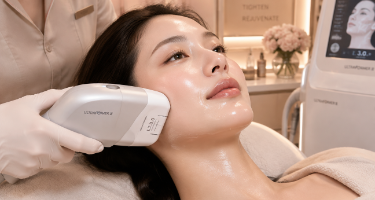
Hello, I’m the chief director of Diorre Clinic near Gangnam Station.
Let me start with the two questions I hear most often in consultations. "I’m looking into HIFU lifting—what exactly do the numbers 1.5mm, 3.0mm, and 4.5mm mean?" and "I heard Ulthera, Shurink, and CoolSonic are all HIFU, but do different handpieces change the results?"
The answer is the same: the basic principle of HIFU (High Intensity Focused Ultrasound) is identical across all devices, but which area is treated with which depth tip makes the actual results feel completely different. In this article, we’ll organize the expected effects by tip depth and explain which parts of the face the handpieces of major devices are suited for.
HIFU works in a way similar to concentrating sunlight at a single point with a magnifying glass, focusing ultrasound energy at a specific depth within the skin to create a 60~70°C thermal coagulation point (TCP, Thermal Coagulation Point). This micro thermal injury triggers a natural healing response, generating new collagen and elastin, causing tissue contraction and leading to lifting and tightening effects.
The key is at what depth this TCP is created. Because the skin layer being stimulated changes, the expected effect also changes, so HIFU devices come with different cartridges (tips) for each depth.
The shallowest tip, it stimulates the upper dermis close to the skin surface.
Shurink Universe applies the dedicated Derma Shurink tip at this depth, forming thermal points only in the upper dermis without affecting the fat layer and improving elasticity.
A newly added depth in Shurink Universe, handled by the Eye Shurink tip.
The core mid-depth tip, targeting the collagen-rich zone in the lower dermis.
The deepest tip, delivering ultrasound energy all the way to the SMAS layer, which is directly addressed in facelift surgery.
Note: If the 4.5mm tip is used indiscriminately in areas with thin fat or existing hollowness, it can lead to fat loss side effects such as sunken cheeks. This is why precise anatomical judgment by the practitioner is so important.
| Depth | Target skin layer | Main effects | Suitable areas | Pain level |
|---|---|---|---|---|
| 1.5mm | Upper dermis | Improved texture and tone, reduced fine lines | Around the eyes, forehead, around the mouth | Mild |
| 2.0mm | Mid-dermis | Tightening around the eyes, improvement of fine wrinkles | For around and under the eyes only | Mild to moderate |
| 3.0mm | Lower dermis | Collagen regeneration, tightening, pore reduction | Cheeks, jawline, forehead, neck | Moderate |
| 4.5mm | SMAS layer | Strong lifting, V-line, improvement of sagging | Cheeks, jawline, neck, double chin | Strong |
The world’s first ultrasound lifting device made by Merz in the U.S., and the gold standard for HIFU approved by the FDA.

A second-generation HIFU device developed by Classys in Korea, approved by the Ministry of Food and Drug Safety.
A next-generation domestic HIFU device that promotes "HIFU without pain."
| Comparison item | Ultherapy | Shurink Universe | CoolSonic |
|---|---|---|---|
| Cartridge depth | 1.5 / 3.0 / 4.5mm | 1.5 / 2.0 / 3.0 / 4.5mm (7 types) | SMAS-layer target (multi-stage) |
| Handpiece type | 1 transducer | 2 types: ULTRA F + BOOSTER (pen) | 2 types: line + pen |
| Image guidance | DeepSEE™ real-time ultrasound | None | None |
| Pain | Strong (anesthesia needed) | Moderate (anesthesia optional) | Mild (no anesthesia needed) |
| Effect duration | About 12~18 months | About 3~6 months | About 6~12 months |
| FDA approval | O (U.S. FDA) | MFDS approval | MFDS approval |
| Fine-area treatment | Possible | Excellent with pen-type booster | Excellent with pen type |
Forehead and eyebrows: 1.5mm (texture) + 3.0mm (tightening) → eyebrow lifting, reduction of forehead wrinkles

Around the eyes: 1.5mm or 2.0mm → improvement of fine wrinkles around the eyes, lifting of drooping outer eye corners (deep tips are not used around the eyes)
Cheeks and cheekbones: 3.0mm (dermal tightening) + 4.5mm (SMAS lifting) → improvement of sagging cheeks, reduction of nasolabial folds
Jawline and double chin: 4.5mm (SMAS lifting) + 3.0mm (dermal support) → V-line formation, reduction of double-chin volume, sharper jawline
Neck: 3.0mm + 4.5mm → improvement of neck wrinkles, tightening of loose neck skin
In actual treatment, it is rare to use only one depth for a single area; instead, tips of multiple depths are combined layer by layer to deliver energy from the dermis down to the SMAS in a multilayered way. This is HIFU’s "multilayer approach," and the reason the practitioner’s experience and judgment ultimately determine the result.
Foreign patients usually begin with "Which HIFU device is the best?" and, as the consultation progresses, move on to more specific questions about combinations.
Q1. Do I have to receive all of 1.5mm, 3.0mm, and 4.5mm?
No, all depths do not necessarily need to be used. The optimal combination depends on skin thickness, fat volume, degree of sagging, and desired effect. For example, for someone with thin skin and sunken cheeks, it is safer to minimize the use of 4.5mm and focus on 1.5mm and 3.0mm.
Q2. Is Ultherapy more effective than Shurink or CoolSonic?
All three devices use the same HIFU principle. Ultherapy has high precision with real-time image guidance (DeepSEE™) and has been validated by more than 110 clinical papers, so its effects and duration after a single treatment tend to be longer. Shurink and CoolSonic are less painful and more affordable, making them suitable for regular maintenance treatments.
Q3. Can HIFU make the cheeks look hollow?
The ultrasound energy from the 4.5mm tip may affect fat cells as it passes through the fat layer. If performed at high output in areas with little fat, sunken cheeks may occur, so it is important to use the 4.5mm tip only in areas with enough fat and avoid areas at risk of hollowness.
Q4. When do results appear after HIFU?
You may feel slight tightening from tissue contraction immediately after treatment, but the full effect appears at its maximum 2~3 months later, when collagen is regenerated. Improvement then continues gradually up to 6 months.
Q5. Can Thermage and HIFU be done together?
Yes, it is a very good combination. HIFU lifts the deep SMAS layer, and Thermage (radiofrequency) stimulates collagen in the dermis for tightening. In building terms, it is like HIFU supporting the steel structure and Thermage firmly finishing the exterior.
Q6. Is CoolSonic really not painful?
It is true that the pain is significantly reduced compared with conventional HIFU. The ACC™ cooling system cools the skin surface and blocks heat and pain. In most cases, treatment can be performed without anesthesia, with only a slight feeling of warmth or soreness.
With HIFU, the results can vary greatly even with the same device depending on the depth of the tip and the treatment area. Smoothing skin texture with 1.5mm, strengthening the dermis with 3.0mm, and lifting the SMAS layer with 4.5mm — this multilayered approach is the secret to a natural yet effective lift.
Most importantly, it is essential to choose the right depth and device for your skin condition and to receive treatment from experienced medical staff who understand anatomical structure accurately. If you’re curious about HIFU lifting, feel free to book a consultation. After directly evaluating your skin thickness and degree of sagging, we will suggest the optimal treatment plan.
References
Hongdae
Reverse Clinic Hongdae Branch
Travel Guide
Foret Seoul

Travel Guide
Foret Seoul
