
Hello, this is GD Clinic.
“My skin feels like it breaks out right away whenever I just work late.”
“I’m definitely not eating that much, but I feel like I keep gaining weight.”
“During periods when I can’t sleep, I keep craving sweets.”
When talking with office workers, we often hear comments like these.
It may be hard to view this as only a skin problem or only a weight problem.
In many cases, repeated sleep deprivation and changes in daily routines affect both skin condition and weight changes together.
In a lifestyle where overtime, company dinners, late departures, and irregular meal patterns repeat like they do for office workers, the body’s rhythm itself is often disrupted.
Even if it seems like simple fatigue on the surface, it may be a change your body is signaling.
Why skin becomes sensitive after lack of sleep
When sleep deprivation continues, the skin barrier function can become more sensitive.
The skin protects itself from external irritants, and without enough rest, its condition can be easily disrupted.
In summer, factors such as air-conditioned environments, strong UV exposure, and skin heat
along with frequent face washing and excessive soothing care can repeat together, making office workers’ skin even more sensitive.
In fact, there are many cases where skin heat is severe, yet only soothing products are repeatedly layered on.
What matters, however, may not be using more products, but checking the current skin barrier condition together with lifestyle patterns.
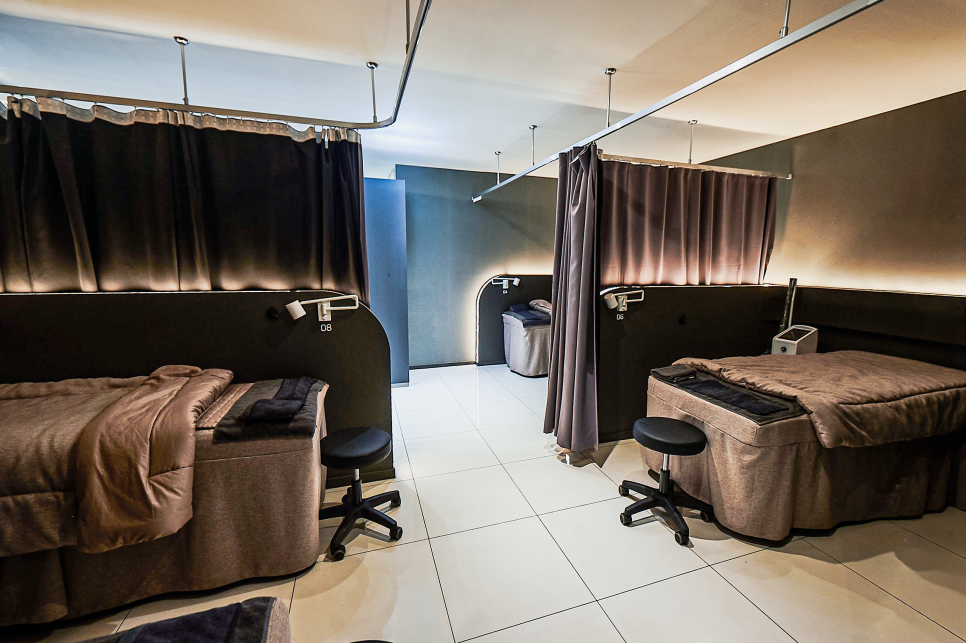
Bed Numbers
- 08
- 06
- 04
Why do sweet foods become more tempting when you don’t sleep?
“On days I work late, I always end up ordering delivery food.”
“Binge eating repeats after work.”
These are common stories in diet consultations for office workers.
When sleep is lacking, changes in lifestyle patterns related to appetite may appear as well.
When you’re tired, sweet food intake may increase, caffeine dependence may rise, or late-night snacking may become more frequent.
In diet consultations, it’s common to see patterns such as barely eating on weekdays and then eating a lot late at night, having a light lunch and drinking many sweet beverages, or repeated binge eating after overtime.
What’s important is to check whether the body’s rhythm itself has been disrupted, rather than viewing it as simply a matter of willpower.
Why your body shape doesn’t change even when your weight drops
.png?type=w966)
DAWOOM LINE
무너진 라인을 세우다!
This is because when extreme dieting and lack of sleep repeat together, a decrease in muscle mass may also need to be considered.
When irregular meals and sleep deprivation continue, factors such as reduced activity, accumulated fatigue, and lower exercise efficiency can follow together.
In this process, even if weight changes appear, the actual body fat distribution or body shape changes may feel different from what was expected.
So for weight management, rather than looking only at the number on the scale,
■ current sleep status
■ lifestyle pattern
■ meal pattern
■ muscle mass changes
it may be important to check these together.
These patterns repeat in office worker life
When looking at skin and diet care near Gangnam Station, sleep deprivation often does not end with simple tiredness.
✔ The skin barrier becomes more sensitive
✔ Skin heat becomes more intense
✔ Appetite patterns become unstable
✔ Late-night snacking and binge eating repeat
and this can lead to a situation where weight management becomes difficult as well.
In summer, as high temperatures and air-conditioned environments repeat together,
it is not uncommon for skin tightness and increased oiliness to appear at the same time.
Even if it looks like a simple lifestyle habit on the surface,
it may be a change connected to the body’s overall condition.
The key point is not simply that you “need to sleep more.”
It may be a process of checking what lifestyle pattern is repeating now and what changes are appearing along with sleep deprivation.
For the skin as well, rather than looking only at oiliness, an approach that considers the skin barrier, heat, daily rhythm, and irritation factors may be needed together.
Weight management is also important not just by reducing food intake,
but by checking sleep and lifestyle patterns together.
Because the approach may vary depending on each person’s habits and health condition, it may be helpful to decide on a plan suited to the current state after consulting a medical professional.
![[Gangnam Lip Tattoo Review] Sinsa Station Lip Blush—can it be done naturally, without looking too dark, like bare lips?](https://image.kbstations.com/2026/08/28/447b33f1-f48c-45d4-93d4-cccd2e56b4ff)
![[Gangnam Lip Tattoo Review] Sinsa Station Lip Blush—can it be done naturally, without looking too dark, like bare lips?](https://image.kbstations.com/2026/08/28/a977b0d0-99ad-40b3-9105-c100a7a1eac7)