
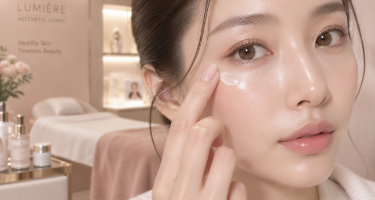
Should you buy eye cream for your teenage child? The answer is not on the ingredient label, but in sunscreen
💡 At a glance
· Common wisdom: If you start applying eye cream early in life, you can prevent wrinkles around the eyes.
· What the latest research says: Up to 90% of visible aging is caused by ultraviolet rays (Ramos-e-Silva, 2013), and the most effective prevention for teenagers is sunscreen, not eye cream.
· Clinical implication: Anti-aging eye creams such as retinoids are for improving fine lines that already exist; for teenagers without wrinkles, moisturizing and sun protection come first.
· Practical application: Dedicated eye care can start as early as the late 20s, and the key is sunscreen, sunglasses, no smoking, and adequate hydration.
Will eye cream applied from a young age really prevent wrinkles?
To put it simply, anti-aging eye cream is not essential for teenagers. The most reliable way to slow eye-area wrinkles is not an expensive eye cream, but sun protection. The causes of skin aging can be broadly divided into two types. Intrinsic aging, which naturally progresses with age, and extrinsic aging, which is accelerated by ultraviolet rays, smoking, and environmental factors. Of the visible signs of aging, a large portion comes from extrinsic factors, especially ultraviolet exposure. In the teens to early 20s, dermal collagen (the protein that supports skin elasticity) is still abundant, and fine lines have not yet fully formed. At this stage, the most cost-effective “investment” is not an anti-aging eye cream, but daily sun protection and a moisturizing habit around the eyes.
Four key facts from the research
Ultraviolet rays cause up to 90% of visible aging
According to a skin aging review (Ramos-e-Silva et al., 2013, Clinics in Dermatology), up to 90% of visible early aging signs such as wrinkles, roughness, loss of elasticity, and pigmentation come from UV exposure. In other words, the starting point for preventing eye wrinkles is not “anti-aging applied to the skin,” but “blocking UV with sunscreen.”
Daily sun protection slows aging by 24%
In a randomized controlled trial conducted in Australia with 903 participants over about 4.5 years (Hughes et al., 2013, Annals of Internal Medicine), the group that applied sunscreen every day showed about 24% less skin aging progression than the group that applied it only when necessary. This is a representative clinical study proving that sun protection is truly effective for prevention.
The eye area is the first part of the face to age
Wrinkles around the eyes are the first facial wrinkles to appear, and in some people fine lines can be seen even before age 30. The skin around the eyes is the thinnest on the face and has fewer sebaceous glands, making it especially vulnerable to external stress and UV exposure.
The effects of eye cream have been proven on “existing” wrinkles
In a clinical study of a retinoid eye cream (AHARet-EM, adults aged 35–65), fine lines around the eyes improved by about 33% after 12 weeks. In a multi-ingredient eye cream study (Yang et al., 2024, Skin Research and Technology), collagen production increased by about 55% after 12 weeks. However, it is important to note that all of these studies involved adults who already had fine lines.

Why the eye area ages first
The skin around the eyes is extremely thin, at about one-third to one-fourth the thickness of the skin on other parts of the face. Because it has fewer sebaceous glands, it dries out easily, and since it folds thousands of times a day when blinking or smiling, expression lines (dynamic wrinkles, wrinkles that form with movement) tend to settle in. When UV exposure is added, the collagen and elastic fibers in the dermis break down, and wrinkles that were first visible only when making expressions eventually become fixed wrinkles (static wrinkles) that remain even at rest. That is why the eye area ages faster and more deeply than other areas.
Age-by-age guide — when to start, and what to do
Teens to early 20s — prevention is everything
- Every day, use a broad-spectrum sunscreen with SPF 30 or higher that blocks both UVA and UVB
- Reduce squinting and direct exposure with UV400 sunglasses
- An eye cream focused on light moisturization (such as hyaluronic acid) is enough — strong anti-aging ingredients are unnecessary
- No smoking, adequate sleep
Late 20s to 30s — moisturization + prevention + early care
- Continue sun protection + strengthen moisturization
- If fine lines start to concern you, consider low-concentration retinoid, peptide, or vitamin C eye creams
- If expression lines become more pronounced, you can consult about a small amount of neurotoxin (Baby Botox)
After the 30s — active management
- Wrinkles that have already settled in are difficult to reverse with cosmetics alone
- Consider procedures such as PDRN skin boosters like Rejuran, HIFU like Ulthera, and Botox through consultation
Principles of eye-area care in DioRE clinical practice
In our clinic, we often get asked, "Should I buy eye cream for my teenage child?" Our answer is always the same — it is much better to spend that money on a good sunscreen and sunglasses. Because the skin around the eyes is thin and sensitive, using strong anti-aging ingredients (high-concentration retinoids, acids, etc.) at a young age can instead cause contact dermatitis or irritation. At DioRE, we divide care by age and skin condition into “prevention stage → moisturization/early care stage → active management stage,” and recommend only what is truly needed right now.

For international patients seeking consultation in Gangnam
It is difficult to accurately judge the stage of eye-area aging by looking only with your own eyes. If you are consulting at a clinic in the Gangnam area, we recommend choosing a place that first distinguishes whether you are in the prevention stage, where sunscreen alone is enough; the early care stage, where low-concentration retinoids are needed; or the active management stage, where procedures such as Rejuran, Ulthera, or Thermage are needed. At DioRE Clinic, we offer multilingual consultations for overseas patients and can handle everything from evaluation to treatment planning in one visit, according to your short stay schedule.
Frequently asked questions (Q&A)
Q1. I'm a teenager — if I start using eye cream now, will I avoid wrinkles around my eyes?
Eye cream alone cannot completely prevent eye wrinkles. Since the biggest cause of aging around the eyes is UV exposure, daily sun protection and light moisturization are far more effective than anti-aging eye cream for teenagers. Strong anti-aging ingredients can actually irritate the thin skin around the eyes.
Q2. At what age do eye wrinkles usually start?
The eye area is the first part of the face where aging appears, and in some people fine lines can be seen even before age 30. They may appear earlier if UV exposure is high or if you smoke. Dedicated care is best started in the late 20s at the earliest.
Q3. Is there a difference between eye cream and just applying a regular moisturizer around the eyes?
If the goal is basic moisturization, using a gentle moisturizer around the eyes is generally fine. However, eye creams are often designed to reduce irritation and include specific ingredients (such as peptides and caffeine) suited for the thin, sensitive eye area. The key is less about whether it is an eye cream and more about whether the ingredients and level of irritation are appropriate for your eye area.
Q4. From what age can retinol eye cream be used?
Retinoids are ingredients clinically shown to improve fine lines, but because they can be irritating, they are usually recommended to start at low concentration in the late 20s to 30s, when fine lines begin to become a concern. Start with a small amount 2–3 times a week, and be sure to use sunscreen together with it.
Q5. Is there anything more important than eye cream for preventing eye wrinkles?
Yes. Sun protection is the most important. A study by Hughes (2013) showed that the group that applied sunscreen daily aged about 24% more slowly than the group that did not, making sun protection a more powerful preventive measure than any eye cream. Adding sunglasses, no smoking, and sufficient moisturization can make it even more effective.
Closing
Starting eye cream in the teens is not harmful in itself, but the key to preventing eye wrinkles lies less in “what you apply” and more in “how well you block UV.” Anti-aging eye creams show their true value at the stage of managing fine lines that have already appeared, so a step-by-step approach based on age and skin condition is the wisest choice. At DioRE Clinic, we guide each person to the care they truly need based on their individual skin condition and age.
ℹ️ This content is intended to provide general medical information and does not replace individual medical care. The effects of products and procedures may vary depending on each person’s skin condition, and accurate diagnosis and consultation should be carried out with a medical professional specializing in dermatologic aesthetics.


