Travel Guide
Lip Blush & Lash Perm, Naturally Changing the Mood 🤍
Foret Seoul


GD Clinic
4.9(50+)

Fillers and Botox: Why Consider Them Together?
When considering fillers, we discussed why it is important to look first at which part of the current face you want to improve, and to examine the overall structure and balance of the face rather than simply “how many cc to inject.”
However, the impression of the face is not determined by just one factor.
Some areas, such as the cheeks or temples, are strongly influenced by volume, while others, such as the glabella and forehead, are affected by repeated muscle movement when making facial expressions.
Therefore, instead of automatically performing both procedures together, it is important to first see whether the current concern is related to volume or structure, to muscle movement, or to several factors influencing the face at once.
What is the difference between fillers and Botox?
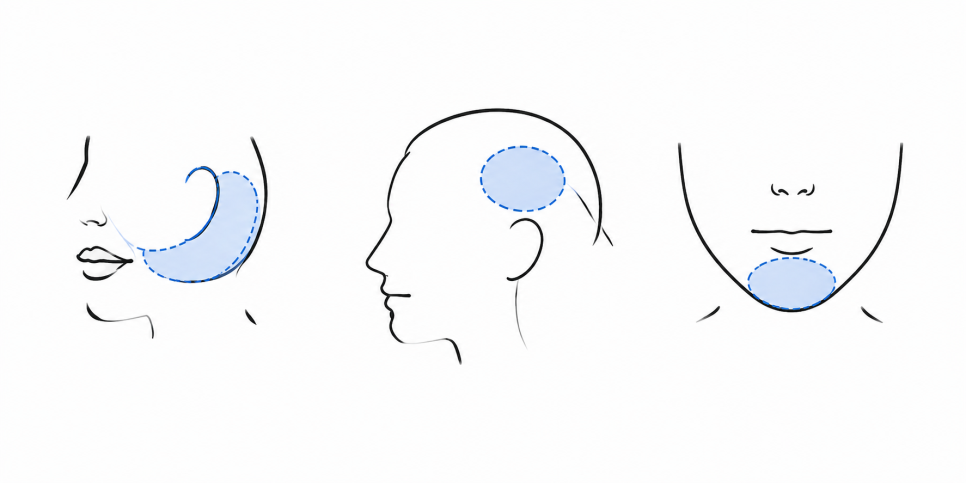
Areas needing volume correction - cheeks, front cheeks, temples, jaw, chin
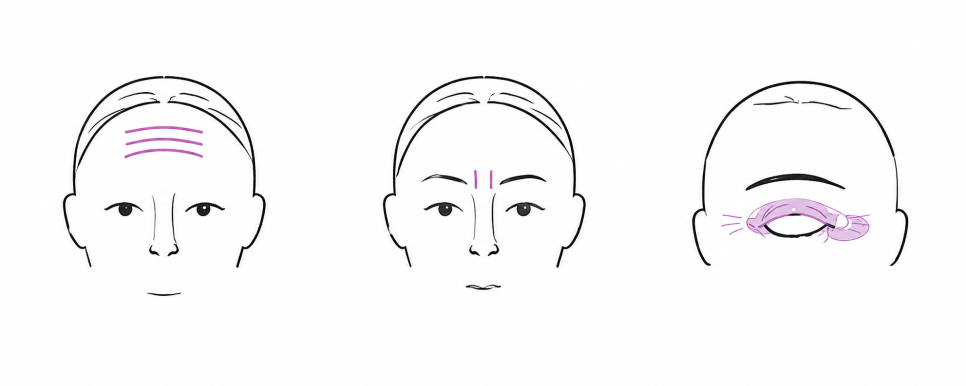
Improving wrinkles caused by muscle movement - forehead - glabella - around the eyes
Fillers may be considered for the purpose of adding volume or improving contours in a specific area by injecting a substance into that area.
For example, in areas such as the cheeks, temples, lips, and chin, we look not only at the needed volume and shape, but also at the balance with the surrounding facial structure. Botox, on the other hand, works by temporarily inhibiting the signals transmitted from the nerves to the muscles, reducing muscle movement. It may be considered in cases where wrinkles appear due to repeated muscle movement during facial expressions, or where the development of certain muscles affects the facial contour.
Fillers are mainly procedures that look at volume and shape,
while Botox can be understood as a procedure that looks at muscle movement and strength.
However, whether the procedure is actually performed, as well as the area, product, and dosage, should be determined after checking the individual's facial structure, muscle movement, and the condition of the skin and soft tissue.
Not all facial changes are due to a lack of volume
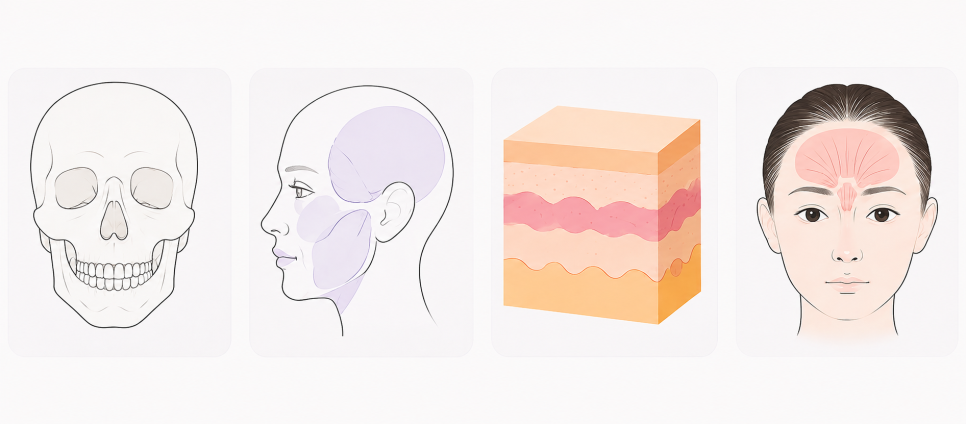
Bone structure - fat and volume - skin and soft tissue - muscle movement
When looking in the mirror and noticing that a certain area appears sunken or wrinkles stand out, it is natural to think,
“Wouldn’t it be better to fill this with filler?”
However, visible lines or contours are not necessarily caused only by a lack of volume.
This is because not only the facial skeleton, fat, skin, and soft tissue condition, but also the muscles that move repeatedly when making expressions can affect the face’s shape and wrinkles. Conversely, simply controlling muscle movement does not restore lost volume.
Therefore, rather than only checking “where is it sunken?” “where are the wrinkles?” we look together at which factors are influencing the changes currently visible.
That is why they are sometimes considered together
It is important to determine the needed scope by distinguishing whether volume and structural factors are more influential in the current face, or whether muscle movement has a greater effect.
That does not mean everyone must undergo both filler and botulinum toxin treatments.
Depending on the current condition, only fillers may be considered, only botulinum toxin may be considered, or neither procedure may be necessary.
We look at both the face at rest and when making expressions
The face looks different when at rest and when making expressions such as smiling or frowning.
Therefore, during consultation, rather than checking only the front-facing face at rest, we may also observe how the muscles move when making expressions such as smiling, raising the eyebrows, or frowning the glabella, as needed.
People may differ in their habits of using muscles and the degree of movement, and there may also be differences between the left and right sides.
So, not only the face’s static shape but also
checking the movement that appears when making expressions can help determine which factors are affecting the current concern.
Pre-procedure side effects and precautions should also be checked
After filler treatment, temporary swelling, bruising, pain, and tenderness may occur.
Possible adverse reactions may vary depending on the individual's health condition, the treatment area, and the products used, so please consult sufficiently with the medical staff in advance about the expected reactions and precautions.