"Director, summer is almost here. Couldn’t you just prescribe the strongest medicine for one month?"
This is something we hear very often in the consultation room at GD CLINIC these days.
I completely understand that sense of urgency when the weather suddenly gets hot.
When your wardrobe gets lighter but you feel unprepared, anyone would start looking for the fastest and most powerful solution.
But whenever that happens, I stop the hand that was about to reach for the prescription pad and put down my pen for a moment.
Then I look at the patient and ask carefully:
"By any chance, have you ever taken medicine before and then not slept a wink at night, or felt your heart pounding so hard that it interfered with your daily life?"

In fact, weight-loss pills, often called appetite suppressants, work by artificially activating the body’s sympathetic nervous system.
They trick the body into feeling as if it’s sprinting on a track, causing it to use energy and forget about hunger.
As a result, your mouth may feel very dry, your heart may race, or your hands may tremble.
This may be a sign that the medicine is working, but for some people it can become a distressing side effect that disrupts daily life.
That is exactly why some people say, "After taking the medicine, I feel foggy, like I drank ten cups of coffee."
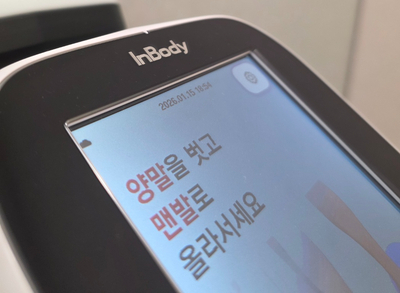
InBody
2025.01.15 18:54
양말을 벗고 맨발로 올라서세요
There is something I always tell those who come to GD Clinic.
"Weight-loss medication should not be a magic pill, but a sturdy cane that helps you on the path to healthy habits."
That is why we do not simply prescribe treatment aimed only at lowering the number on the scale.
Everyone has different muscle mass, and different eating habits and lifestyle patterns.
Some people struggle with late-night eating syndrome, while others are stressed by false hunger.
That is why at GD Clinic, we place great importance on '1:1 in-depth consultations.'
Precise Body Composition Analysis |
We accurately read the current state of your body fat and muscle. |
Lifestyle Pattern Analysis |
We talk it through together to find out why the weight gain happened and where things started to go wrong. |
Step-by-Step Customized Adjustment |
We do not start with strong medicine that puts stress on the body. We begin with a proper dose that your body can adapt to, then make fine adjustments based on your condition. |
[1-Minute Tip from the GD CLINIC Director]
Why sleep is the best medicine while taking weight-loss medication!
Some people have trouble sleeping because of the medication ingredients.
Whenever possible, it’s best to take the medicine in the morning.
Getting a good night’s sleep helps your body’s metabolism work properly, which also helps body fat come off more easily.
In the evening, relax your body with a warm glass of water.
Of course, there are also things I should honestly tell you as a doctor.
Depending on a person’s constitution, weight-loss medication can cause dizziness, constipation, and mood changes such as irritability or low mood.
In particular, long-term excessive use can lead to dependence, so caution is needed.
That’s why, after you reach your target weight, we carefully guide you through the 'tapering' process of gradually reducing the medicine.
It helps minimize rebound effects (yo-yoing) and supports your body in adjusting its metabolism on its own.
This summer, I hope you’ll start with care for your body rather than rushing into things.
We’ll be more than just a place that prescribes medicine; we’ll be a pacemaker cheering sincerely for your healthy change.


![[Gangnam Lip Tattoo Review] Sinsa Station Lip Blush—can it be done naturally, without looking too dark, like bare lips?](https://image.kbstations.com/2026/08/28/447b33f1-f48c-45d4-93d4-cccd2e56b4ff)
![[Gangnam Lip Tattoo Review] Sinsa Station Lip Blush—can it be done naturally, without looking too dark, like bare lips?](https://image.kbstations.com/2026/08/28/a977b0d0-99ad-40b3-9105-c100a7a1eac7)